
Biodiversity Ambitions Face Financing and Land-Use Realities

During the penultimate week of May the Department of Forestry, Fisheries and the Environment (DFFE) played host to various sustainability events at Birchwood Hotel in Gauteng.
Wildlife Ranching South Africa (WRSA) attended the event to find out more about what DFFE, SANParks, and financial role players, such as the Development Bank of Southern Africa (DBSA), are doing on a national level with regard to biodiversity and sustainability.
The highlight of the week happened on Friday, 22 May 2026, when South Africa marked the International Day for Biological Diversity under the global theme, “Acting locally for global impact”, placing renewed focus on how local conservation efforts contribute to international biodiversity goals ahead of the Seventeenth UN Biodiversity Conference (COP17) in Armenia later this year.

A key message emerging from the discussions was that biodiversity conservation cannot be achieved by government alone. Deputy Minister Narend Singh emphasised that South Africa’s updated National Biodiversity Strategy and Action Plan (NBSAP), aligned with the Kunming-Montreal Global Biodiversity Framework (KMGBF), will be implemented alongside the White Paper on the Conservation and Sustainable Use of South Africa’s Biodiversity. This framework seeks to balance conservation, sustainable use and equitable benefit sharing.
Central to the discussions was the need for a “whole-of-society” approach, recognising the role of communities, landowners, private enterprise and civil society in biodiversity management.
Financing biodiversity also emerged as a major concern. While biodiversity stewardship and conservation initiatives have attracted substantial local and international investment over the past two decades, speakers acknowledged a growing biodiversity finance gap that threatens implementation and long-term sustainability.

Government programmes, private sector partnerships and corporate social investment were highlighted as important mechanisms to strengthen biodiversity funding and support stewardship initiatives. Discussions noted that conservation financing must increasingly demonstrate economic value, support local livelihoods and contribute to broader development goals such as climate resilience, water security and job creation.
South Africa’s role as host of the CBD Technical and Scientific Cooperation Centre further reinforces the country’s role in regional and international biodiversity collaboration.
SANparks’ strategy to address declining returns
Dr Danny Govender, General Manager of Sustainability at SANParks, addressed the financial sustainability of South Africa’s national parks over the next two decades.
“In many ways, SANParks is asset-rich," Dr Govender said, noting that the organisation manages around four million hectares of land and generates approximately 70% of its income through tourism, with six million visitors annually across 20 national parks. “However, this asset richness must be contrasted with a cash-poor reality.”
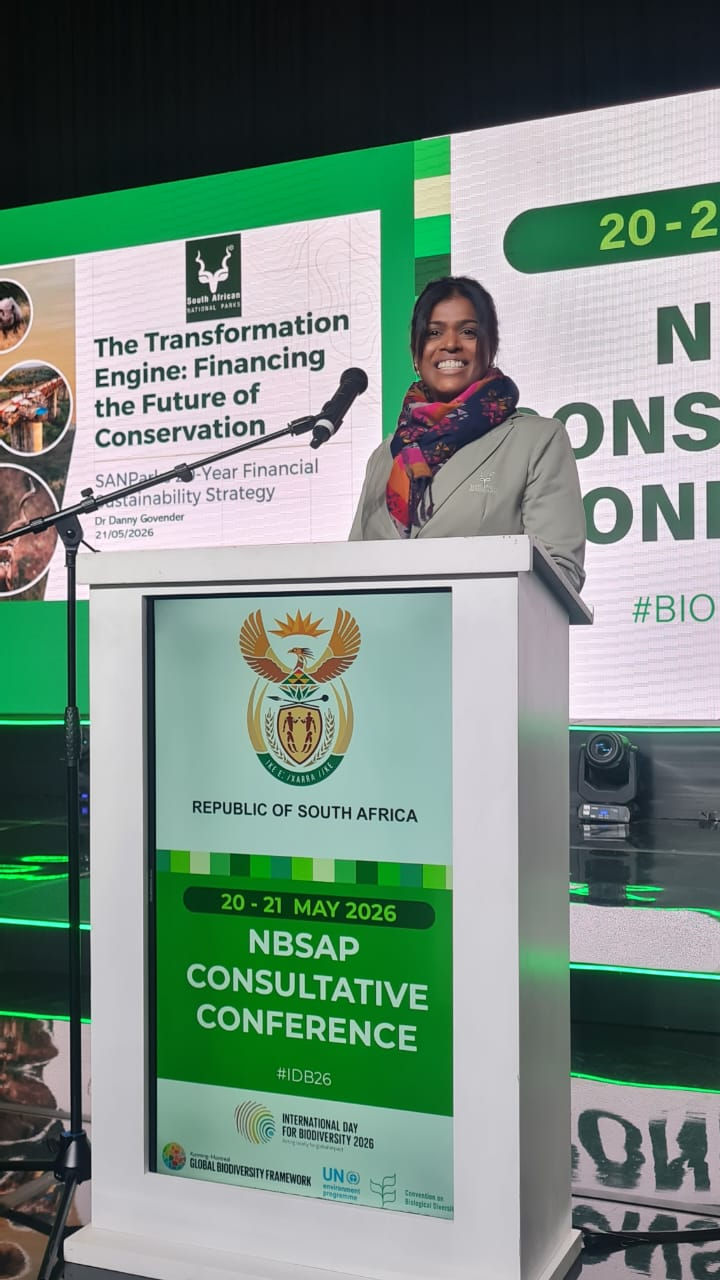
Only four national parks generate a financial surplus, which must support conservation management across the wider network. Around 90% of SANParks’ assets are non-liquid, while infrastructure maintenance backlogs stand at approximately R10 billion.
Flood damage, climate change impacts and below-inflation government funding continue to widen the financial gap. Dr Govender stressed that conservation cannot remain confined to protected areas alone and highlighted SANParks’ emerging “mega living landscape” approach, where sustainable livelihoods and conservation coexist beyond park boundaries.
To address these challenges, SANParks developed a financial sustainability strategy focused on five pillars: enhancing tourism revenue, monetising natural capital, mobilising external finance, expanding partnerships and improving operational efficiency.
Dr Govender added that South Africa is emerging as a leader in conservation finance through initiatives such as rhino bonds, water bonds and impact investment models, while SANParks is also exploring carbon credits, biodiversity credits and other conservation-based financing mechanisms.
Development finance unpacked
Mookho Mathaba, a climate finance specialist with the DBSA, outlined the bank’s growing role in climate and biodiversity finance, emphasising that biodiversity conservation can no longer rely solely on grants. Although DBSA does not receive government funding directly, it raises capital through financial markets and invests in infrastructure and development projects across Africa.

The speaker explained that DBSA works closely with municipalities and private sector partners, providing project planning, technical assistance and financing. Through initiatives such as the Green Fund and accreditation with international climate finance institutions, including the Green Climate Fund (GCF) and Global Environment Facility (GEF), DBSA has expanded its role in sustainable finance.
A key challenge identified is the disconnect between investors and biodiversity project developers. While investors often claim there are too few bankable projects, project developers argue that funding is unavailable. DBSA seeks to bridge this gap through innovative “de-risking” finance models, using concessional funding, guarantees and blended finance structures to attract private investment.
The bank is also piloting innovative instruments such as biodiversity and carbon credits, nature-based infrastructure projects and outcome-based bonds. Central to these efforts is a planned US$300 million Biodiversity Investment Facility aimed at supporting conservation and biodiversity projects through flexible, tailored financing mechanisms.


Comments